
The Lab · exhibit III · retired
Comic Scry
An iOS app that looked at a comic cover and told you what the book was worth, backed by real sold listings. It was live for two months in 2026. I took it down on purpose, and this is the marker I'd rather leave than a dead link.
- Shipped
- June 16, 2026
- Retired
- August 18, 2026
- Last build
- v1.0.4
- Scans I ran myself
- 401
- Users
- Me, mostly
- Built by
- One person and Claude
What it did
You stood over a longbox you hadn't opened in twenty years and pointed your phone at a cover. It came back with a tier — Bulk, Modest, Solid, High, Major — and a price range you could go check yourself against actual completed sales. Keep it, sell it, bulk-lot it. Next book.
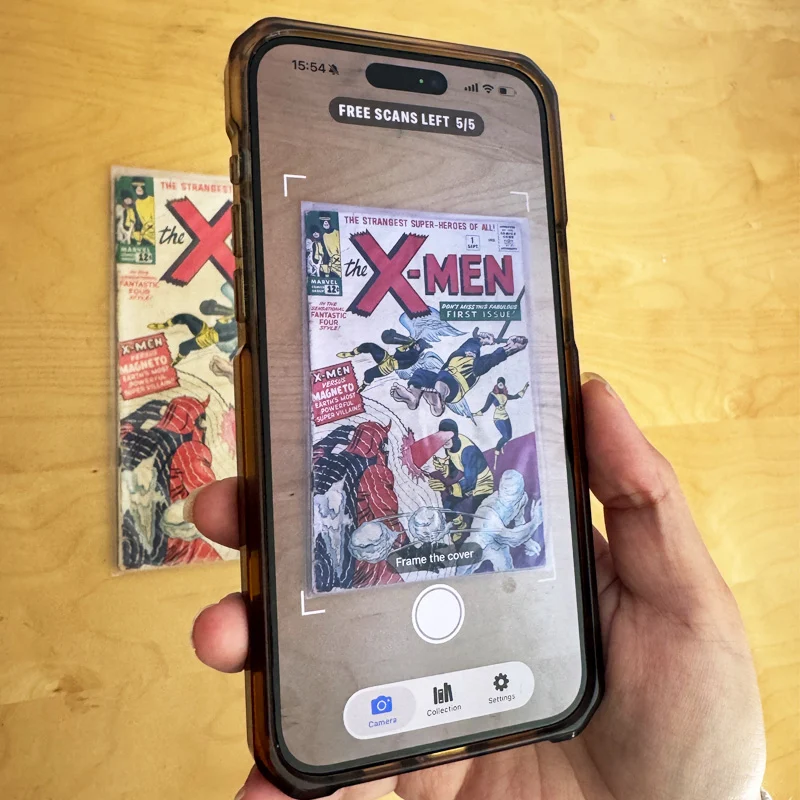
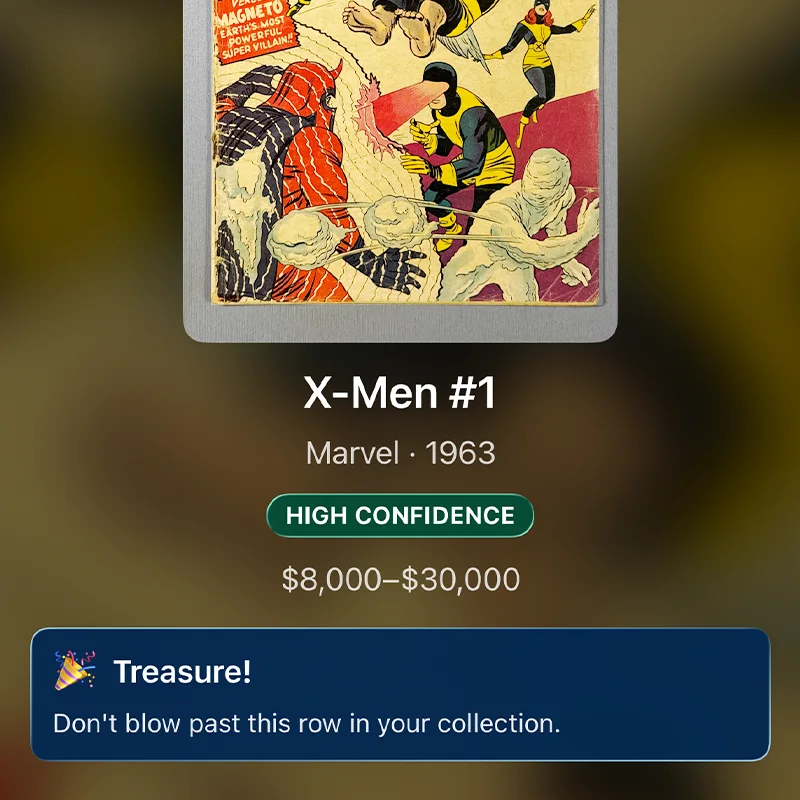
No account, no signup, no comic knowledge required. That was the whole pitch: the box is the obstacle, so make the box fast.
I'm a Marvel and X-Men kid who still owns the actual books from those actual days, and I could never find the tool I wanted. So I built it. It was the first consumer app I ever shipped, after fifteen years of wanting to.
The camera wasn't the fast path
The pitch was point-and-shoot, and for a stranger holding a box they can't identify, that's still the right answer. I wasn't that person. I mostly know what's in my own boxes — and once you know the series, typing beats photographing. It isn't close.
So I built myself a web admin, and I ended up using it more than the app. I'd type Elfquest 1-32 and it would go find the whole run — issues, editions, cover art, prices — and hand it back as a list of confirmations to approve or correct. One line of typing, thirty-two books, a few seconds of checking. The phone was for the books I couldn't name. The keyboard was for the ones I could.
That's the finding I'd carry into the next thing: the input that demos well isn't always the input that's fast, and which one wins depends entirely on how much the person already knows. I built the app for someone who has no idea what's in their collection, and then found out I wasn't him.
The part I'd build again
Early on, the app told me a $7 book was worth $200. It said it with total confidence, because that's what these things do.
Fixing that became the actual product. The interesting engineering in Comic Scry was never the cover recognition — it was teaching the thing to know when it didn't know. It identified the book from the art, looked for real sold listings for that exact issue in that condition, and when it couldn't find enough of them, it said so instead of inventing a number. A confident wrong price isn't a smaller version of a right one. It's worse than silence, because someone might sell on it.
That's the piece I'd carry into anything else I build with a model in it. Everything else — the catalog, the identifiers, the eval harness that caught regressions before users did — was scaffolding for that one behavior.
Why it's gone
Because it did what I built it for, and what came next wasn't a job I wanted.
I built it because I felt compelled to — which is the only reason I've ever finished anything. Under the compulsion were two real goals: learn computer vision by doing something serious with it, and get my own comics inventoried. Both are done. The boxes in my basement are catalogued, and I know how to point a model at a photograph now. There was a third thing I didn't expect to value as much as I do: the App Store itself. Certificates, review, pricing tiers, in-app purchase plumbing, privacy disclosures — the whole apparatus, learned once, for real. I've spent that knowledge twice since.
What I didn't want was the business underneath the app. Taking Comic Scry seriously as a product means going deep into the comics secondary market — grading disputes, census data, the CGC ecosystem, price movements, the forums, the cons. That's a real field with real experts in it, and doing it justice would mean living there for a few years. I like comics. I don't want that job.
So I pulled it from the App Store and switched off the backend — three Cloudflare Workers, a database, a hosted model deployment, and a cron job firing seven hundred and twenty times a day. An app you're not going to push further still costs money, still needs patching, still breaks at inconvenient times, and still takes up the part of your head that should be on the thing you actually want to be doing.
Here's the part I think people haven't priced in yet. AI-assisted building got fast enough and cheap enough that a whole shipped app can be a question you asked and got an answer to. Comic Scry cost me weeks, not years. I don't have to keep it alive out of respect for what it cost, because it didn't cost that much. Build it, find out, turn it off, go do the next one. That's not failure with a nicer name — it's the actual advantage, and refusing to use it is how you end up maintaining someone else's idea of your career. The apps are cheap now. The years still aren't.
What I actually got for it
Computer vision I'd only read about, an App Store education that transfers to every app after it, a catalogued collection, and a shipped consumer product with my name on it — alone, start to finish, after fifteen years of wanting to.
And a better question to ask up front. When building stops being the expensive part, the expensive part becomes choosing which business you're willing to go live inside for a few years. I answered that honestly here, probably for the first time.
It changed how I picked the next one. Gurn is built so that playing it produces something you'd want to share — the clip is the product, not marketing bolted on afterward. Not because this app taught me a hard lesson, but because I knew going in what kind of work I'd still enjoy the day after it shipped.
What's still here
The launch post is up, unedited, with a note on top saying how it ended: I Used to Hide My iPhone at Microsoft. Today I Shipped an iOS App. I'd rather leave the enthusiastic version standing next to the outcome than quietly rewrite it into something wiser than I was.
The rest of the apps are in the Lab. I write down how they're built, and how they go wrong, in the writing.
Comic Scry · 2026–2026 · asked, answered, switched off