
Four Days, One Product, and the Part That Actually Made It Work
Friday I started. Tuesday morning I shipped Obaron — a live product, real checkout, automated scan pipeline, web reports delivered by email. Four days.
Now I want to say something important before you screenshot that and add it to your “AI makes building trivial” folder.
It doesn’t. Not yet.
What I actually shipped
Obaron is an AI Readiness auditor. You put in your domain. It crawls your site, scores how visible you are to AI agents — Codex, Claude Code, Gemini, anything that crawls the web — and sends you a web report with what’s broken and how to fix it.
The score is 0–100. Most dev docs sites are under 60. Most of them have no idea.
The free tier gives you a Lightning Scan: your homepage, your score, three quick findings. The paid tier — $30 right now, normally $49 — scans a smart ~30 page sample and gives you the full picture: category breakdowns, executive summary, prioritized fix list.
That’s the product. Four days. Me, Claude Code, a few Claude agents, and some Codex and Grok and Gemini mixed in where they fit.
Why that number is real, and what it doesn’t mean
The AI-built-this-in-a-weekend claims are everywhere now. I’m guessing a lot are demo-ware with a nice landing page and no real behavior underneath. So why did four days work for me? The answer isn’t “AI is that good.” Not yet.
Three things made it possible.
I had a prototype from last year. Not throwaway code — a working scan pipeline I’d built while figuring out what AEO even meant. The four days weren’t starting from zero. They were taking something that existed and making it shippable.
I’ve been living as an AI-native for the past year. I don’t mean “I use Claude.” I mean I’ve restructured how I work around AI agents as actual collaborators — workflows, review loops, failure modes, where to trust and where to check. That fluency is what let me move fast.
I’ve been a product engineer for 25 years. I know what a shippable thing looks like. I know how to read a codebase, how to write a spec that an agent can follow, how to tell the difference between “tests pass” and “this actually works.”
Take any of those three away and the number changes. That’s not false modesty — it’s the honest accounting you rarely see in the launch posts.
Three things I learned from the build
Here’s what’s actually useful to take from this. Not “AI is magic.” Specific things.
One: Simple agents are closer than you think.
You don’t need a framework or a complex orchestration setup to get the productivity gains. Claude Code has an --append-system-prompt flag you can put in a shell alias. That’s an agent. Give it a persona, tell it what project it’s on, what to focus on. I have a breakdown of this exact pattern over on AATT. Start there.
Two: Tell agents both what to do AND what not to do.
This is the thing most people skip. “You are auditing code, not writing it.” gets you something. “You are auditing code, not writing it, and don’t open with a summary of the change, etc.” — that’s the version that doesn’t stall for ten minutes generating a project timeline while you’re trying to ship. (Claude in particular will estimate in human time and then do a week’s worth of work in 23 minutes. C’mon guy! You know we’ll be done in a few minutes!)
The DO/DON’T pairing is how you compress the back-and-forth. Agents are trying to be helpful. If you don’t tell them what helpful looks like and what it doesn’t, they’ll make their best guess. Give them the constraint and the constraint does the work.
Three: Read the plans. Review the output.
This is the one that burns people. AI agents are spectacular at wholistic review — catching bugs, checking architecture, spotting patterns. They are not yet good at customer experience judgment. They can’t tell you if the UX is right. They can’t tell you if the copy lands.
More importantly: tests pass and apps break. I cannot say this clearly enough. An agent can write tests that all pass against code that is completely incorrect from a user perspective. You have to look at the thing. You have to click through it. The loop is: write the plan yourself (or review it carefully), let the agent build, then you QA it with your own hands.
The human load is still real. I can reduce it with more investment. Right now, we’re just building fast.
Go check your score
Obaron is live. The free Lightning Scan takes 6-60 seconds. Put in your docs domain — or your product site, or your blog — and see where you land. Most people are surprised. The score is specific, the findings are real, and the full audit at $30 is the clearest action plan I know of for closing the gap between what you built and what AI can actually find.
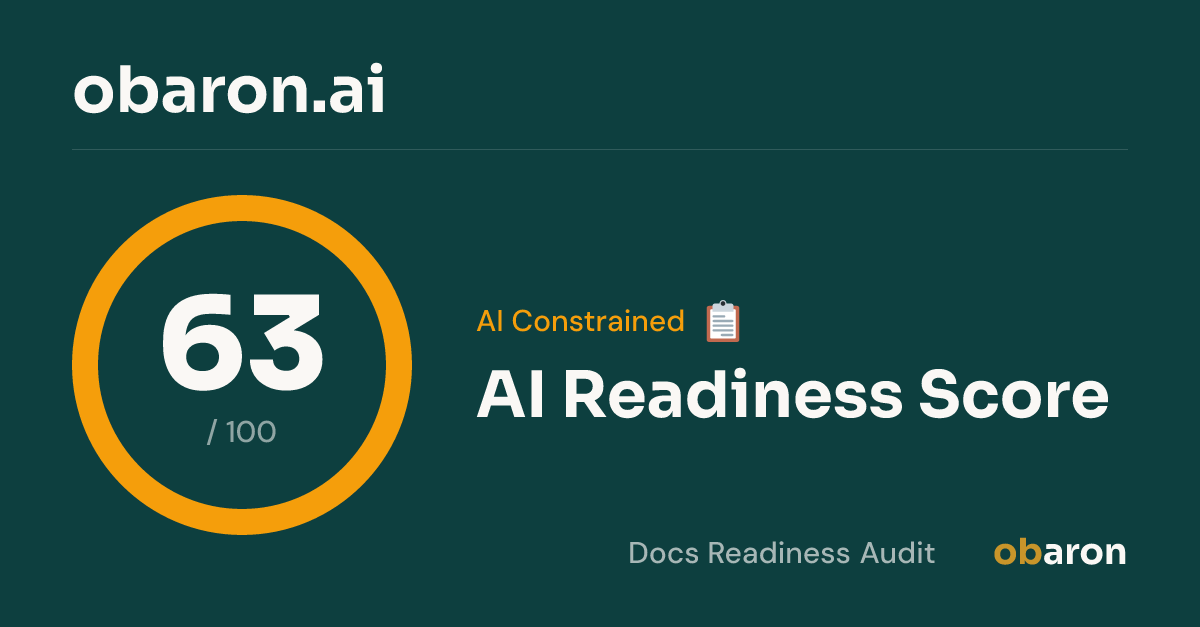
The secondary thing you can do — the free thing, if you want to help — is share your homepage score. We made the share card customizable. That’s the easy way my network can actually support this launch. (If you do please share it with me and I’ll like and comment in return :)
One more thing: each score tier comes with multiple emoji options, and one of them per tier is super rare. See if you can find it.
Go to obaron.ai.
