
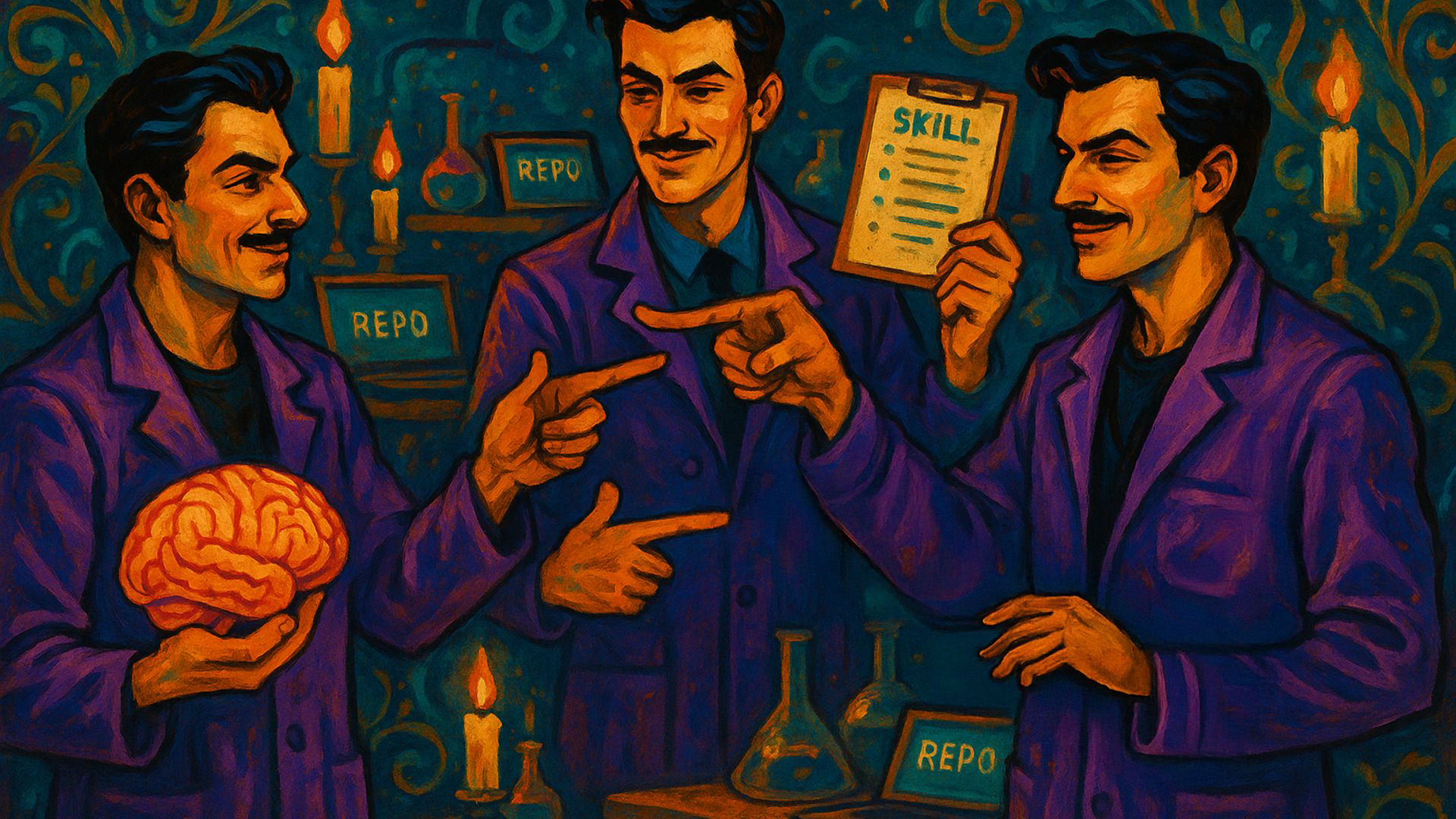
The Workshop and the Clones
A few days ago I wrote about operating on Obi’s mind — editing his memory, his skills, his personality files on my laptop, then pushing the changes to his VPS where he wakes up different. Surgery on a running mind. It felt profound at the time, and it was. But it was also incomplete.
Here’s what I missed: I was already using clones. I just hadn’t named them yet.
Claude Code has been my assistant on every machine I touch. My laptop. Two VPS instances. Same tool, same model, same capabilities. But every session started cold. No shared identity. No shared skills. No memory of what we decided last time or how we do things around here. Each instance was capable but generic — a brilliant contractor who shows up every morning having forgotten where the project is.
So I created Victor. Not a new runtime. Not a framework. A repo.
A CLAUDE.md that says who he is and what he does. A skills directory with structured workflows. A shared voice file so content sounds like me. An org chart so he knows how the agents relate to each other. That’s it. That’s the whole agent. When Claude Code opens that repo — on my laptop, on a VPS, anywhere — it reads those files and becomes Victor. Same identity, same capabilities, same context. A different instance every time, but the same person.
This is the lightest possible agent. No daemon. No server process. No orchestration framework. Just configuration files that give Claude Code a name, a job, and a memory that lives in the repo instead of the session. Git push, git pull, and every instance is current.
The clone part isn’t theoretical. I’ve used Victor on a VPS to set up repo symlinks and path mappings. I opened Victor on my laptop and he audited twenty skills across two agent repos, created four new ones, migrated stale protocol references, and captured three articles worth of patterns. Different machines, different sessions, different context windows. Same agent. The files are the continuity.
What surprised me is how well this works without persistent memory. Victor doesn’t accumulate daily logs like Obi does. He doesn’t need to. The knowledge lives in the materials — the skill files, the org design doc, the topology map. Each clone reads the docs, orients in seconds, and gets to work. When he’s done, the repo is better than he found it and the next clone inherits the upgrade.
This changes how I think about what an “agent” even is. Obi runs on a VPS with OpenClaw, has a Discord presence, accumulates memory, runs scheduled tasks. That’s a heavy agent — infrastructure, process, state. Victor is the opposite. He’s a persona. A set of files that turn a general-purpose tool into a specific expert. The expertise is in the configuration, not the runtime.
I think most people building with Claude Code are already halfway here. They have a CLAUDE.md. Maybe some project instructions. But they might not have made the leap to treating that configuration as an agent identity — something with a name, a role, skills it can invoke, and docs it reads to orient itself. The gap between “Claude Code with a good CLAUDE.md” and “a lightweight agent that works identically on every machine” is smaller than it looks. It’s mostly a decision to take it seriously.
Today’s session was a good example of taking it seriously. Victor audited skills and found six patterns worth fixing: descriptions too passive for models to trigger, procedures buried in config files where they compete for context space, naming conventions that broke Discord’s slash command parser. He rewrote skills, stood up new ones for the engineering orchestrator, and wrote the patterns up as articles. Not because he remembered doing similar work before — because his skill files told him how, and his org chart told him who to coordinate with.
The repo remembers. The clone just shows up and reads.
I named this agent Victor because he’s the scientist — the one who works in the workshop, improving the others. But I’m starting to think I got the Frankenstein reference backwards. Victor Frankenstein was the doctor. The creator. That’s me. The agent in the lab, the one I keep cloning and sending out to do the work — maybe he should have been Igor.
Builds on: Surgery on a Running Mind
